
Nearly two decades ago, then defence minister George Fernandes said: 'China has built roads up to the border, while there has been negligence on India's part.' Since Fernandes uttered these brave words, what has been done on the Indian side? The Modi Sarkar is apparently trying, but little has been achieved so far, says Claude Arpi.

Lack of consumer confidence remains a key issue, but these brands are addressing the challenge in their own unique ways.

'The attempt to make Aadhaar mandatory has now emerged as an act of bullying by government agencies, turning citizens into subjects by making fundamental rights conditional on biometric identification,' says Gopal Krishna.

After many false starts, India may well be at the inflexion point that Deng Xiaoping took China to post-1978. The window of opportunity is wide open right now, says Rajeev Srinivasan.
All you need to know about preparing for the Civil Services examination

A glance back at some important events that occurred in 2018.
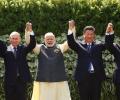
Narendra Modi's success at the BRICS summit is the best Diwali gift for India's diplomacy and marks her ascendancy to global leadership, says Tarun Vijay.

'It was almost as though there was widespread relief that the defence bureaucracy, and the minister, could find someone willing to shoulder the blame for everything that had gone wrong with the services under Antony's charge -- the poor preparedness of the forces, slow acquisitions caused by indecision, cancellation of contracts and whimsical blacklisting of defence contractors over the tiniest suspicion that they may have paid speed money or kickbacks.'

'There is nothing traitorous about highlighting the poor record of your own government. If the Indian government does something wrong, we all have the right to point this out at any forum, international or national.'

'Only when you see it, you will understand how bad the situation is.' 'The soil in the entire mountain range is soaked with water now and that uproots the trees.' 'It is frightening to see the way the soil drags down the trees with great force.'

'This is not a small change, it's a BIG change. People wanted to hear the voice of their PM. They can do so now. This is a big parivartan.'

'India alone cannot walk the path of peace. It also has to be Pakistan's journey to make,' says Prime Minister Narendra Modi at the government's geo-political flagship initiative "Raisina Dialogue-II".

There are unprecedented political implications of identification based on 'biological attributes of an individual', such as employed by Aadhaar, warns Gopal Krishna.

'Growth is predicated on the misery of large sections of people.' 'Maybe Hindutva will be used to suppress any such unrest.'

All this is happening at a time when aluminium prices in the world market are firming up.

'We use the word "historic" perhaps too much, but the prime minister's visit certainly was historic in so many ways.'

'Without it, it is going to be much, much, much, much worse.' 'In the meantime, we really need to work on a sort of war footing, given that it is a natural disaster, provide relief, provide essentials, till we get biological herd immunity, we need to get economic immunity, and also social immunity.'

'Dulat's professional successors in the game would now find it that much harder to access/create meaningful sources/assets needed for effective functioning in a place like Kashmir. By blowing their cover the former top spy has undone whatever he might have been able to add to his organisation's resource kitty.'

A glance back at some of the important ups and down Indian Inc faced in 2018.

Following is the full text of Prime Minister Manmohan Singh's speech at the Central Party School in Beijing on Thursday:
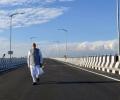
'I say Modi was India's last chance.' 'Because the kind of work this government has done -- I'm talking about physical delivery -- is fantastic, like no time in our history.'
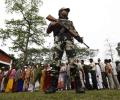
L K Advani's observation on Narendra Modi, an attempt to cut the BJP's prime ministerial nominee down to size, billing him a mere event manager like Vijay Raaz in Mira Nair's film Monsoon Wedding, speaks volumes about their differences... In the coming days, the Congress and BJP may lock horns over the AgustaWestland chopper deal. In an Italian court, Guido Haschke, one of the accused middlemen who allegedly bribed the Indian side, has sought a plea bargain to reduce his jail term if convicted. On or around April 11, we will know how much Haschke is ready to reveal. Rediff.com's Sheela Bhatt detects which way the political wind is blowing these days.
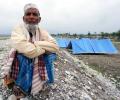
The recent bouts of violence by suspected Bodo militias that killed over 30 hapless 'Muslims, mostly children and women, and rendered several thousands homeless in lower Assam recently, once again offers a shocking glimpse of the horrendous game of violent communalism being played by the Congress government of Assam in furtherance of its cynical power politics for the last several years.' 'The result is, the state is a simmering communal cauldron that sporadically erupts at the slightest real or imagined provocation,' says R N Ravi.

Muzzling NGOs is unbecoming of a democracy. Self-confident democracies encourage, indeed applaud, the involvement of citizens' associations, including NGOs, in social and political decision-making and development planning. Instead, our paranoid government bullies and terrorises them, says Praful Bidwai.

It is a dark legacy bequeathed by Nehru to India. In its DNA lies the subconscious fount of India's schizophrenic geopolitics that forsook in one sweep all its historically-entrenched strategic interests in Tibet in favour of China, says R N Ravi, on the 60th anniversary of the Panchsheel Agreement.

Most juvenile remand homes are in appalling condition and need a massive overhaul. But whether redrafting the law will bring down juvenile crime is the moot question. What is required better remand homes, more specialised care rather than to expose young people to the trauma and stigma of adult jails, says Rashme Sehgal.

'Let me talk about young Indian startups with their hearts in the right place and how they are proving that innovations that represent 'affordable excellence' -- breaking the myth that 'affordability' and 'excellence' cannot go together -- is indeed possible!' says Dr R A Mashelkar, the eminent scientist, in this fascinating feature.

'Bangladesh is a country of immensely organised terror outfits.' 'His murder has left a deep scar. Why, why, why, my mind asks me. How could this happen to my Avijit?' asks Professor Ajoy Roy.
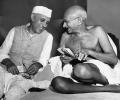
'How come with Nehru at the helm, India missed so many buses? He had such unchallenged power that he could have taken the country in any direction he wanted. The sad conclusion is inescapable that Nehru let things drift in true Hamletian ambivalence,' says B S Raghavan.
'Greenpeace has been brutal in targeting both India and the Manmohan Singh government. The push to go after Indian coal is driven by its long-term agenda. What is surprising is that China has not been meted out the same treatment, despite the fact that the rise of China as an economic power has been built around generating power from coal. 'Being richer and more affluent, yet far less democratic, there is less room for an NGO such as Greenpeace to drive home a complicated global agenda, so there is more of a tendency to go along with anything the Chinese offer despite China being the biggest by far with regard to coal use. But for India, it reserves tougher prescriptions, notably for its middle class, says Srinivas Bharadwaj.

'India should think big: About how in a multi-polar world, India can indeed be one of the poles, rather than being a secondary power that has to worry about 'alignment' with one of the poles. A G3 in other words, India should look to getting others to align with itself rather than the US or China,' says Rajeev Srinivasan.
